Wandsworth
Wandsworth/2025/1138
13 Flat 1 Streathbourne Road SW17 8QZ
- Reference
- Wandsworth/2025/1138
- Authority
- Wandsworth
- Application type
- Works to a T.P.O. Tree
- Address
- 13 Flat 1 Streathbourne Road SW17 8QZ
- Postcode
- SW17 8QZ
- Status
- FINAL DECISION
- Decision
- Refuse 15/10/2025
- Received
- 3 Jun 2025
- Started
- 3 Jun 2025
- Source council
- Wandsworth
- Council source record
- View public record
- Public data licence
- Open Government Licence v3.0
- Record updated
- 13 Jul 2026
- SEO index generated
- 24 Jul 2026
Location
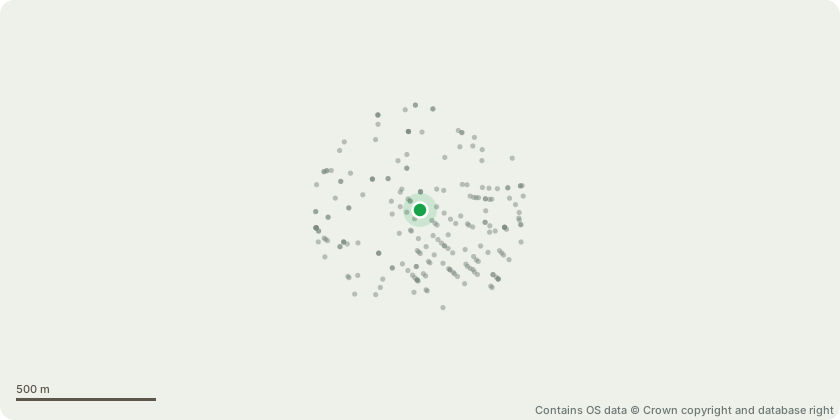
Approximate location - Contains OS data © Crown copyright and database right
Proposal
T1 Lime - Fell Structural Decay and Cavities The tree presents visible decay pockets, which are indicative of internal breakdown of structural tissue. These cavities can compromise the tree's overall integrity, increasing the risk of stem or limb failure. Decay in lime trees often originates from previous pollarding wounds or pruning cuts, leading to fungal colonisation and a weakening of core wood. Exposed and Compromised Root System The tree exhibits exposed surface roots, potentially caused by soil erosion or historic ground disturbance. This can lead to reduced anchorage and greater vulnerability to windthrow, particularly in saturated ground conditions. In addition, root damage or decay may already be present, which cannot always be fully assessed without invasive investigation (e.g., air spade or ground-penetrating radar). Excessive Suckering and High Maintenance Lime trees are known for prolific basal and epicormic suckering, particularly when stressed or repeatedly pollarded. This requires frequent cyclical maintenance, currently estimated at every 2???3 years, to manage both form and safety ??? an unsustainable burden for many private garden settings. Awkward Position in Garden Context The tree is situated in an awkward position, limiting access for maintenance and increasing the risk of damage to surrounding structures or landscape features during pruning operations. Its position may also cause disproportionate shading, root competition, or conflict with intended garden use or development. Lifecycle and Species Considerations While lime is a long-lived species, mature specimens in suboptimal conditions (restricted root space, historic pollarding, or urban garden settings) can deteriorate structurally well before their natural lifespan. Removal at this stage may allow for more appropriate replanting with a lower-maintenance and site-suitable species.
Key dates
- Received 3 Jun 2025
- Started 3 Jun 2025
Planning history / related applications
No related planning applications have been identified in the current public OGL dataset.
Inside plotEdge
Go beyond the public record
This page is the public OGL record. plotEdge adds the private intelligence layer for this site - open it in the app to unlock:
- Ownership & title Registered owner and title from HM Land Registry.
- Viability & build potential Site scoring and development upside.
- Constraints Flood risk, green belt, conservation areas and designations.
- Approval signal Planning risk and approval-likelihood analysis.
- Comparable applications Decisions on similar nearby sites, side by side.
- Status alerts Get notified the moment this application changes.
Source: public planning application data from Wandsworth, reused under the Open Government Licence v3.0. View the council source record. Council documents and drawings are not republished on plotEdge.