Runnymede
Runnymede/RU.24/1376
2 Bulkeley Close Englefield Green Surrey TW20 0NS
- Reference
- Runnymede/RU.24/1376
- Authority
- Runnymede
- Address
- 2 Bulkeley Close Englefield Green Surrey TW20 0NS
- Postcode
- TW20 0NS
- Status
- WITHDRAWN
- Decision
- Withdrawn Decision
- Source council
- Runnymede
- Council source record
- View public record
- Public data licence
- Open Government Licence v3.0
- Record updated
- 12 Jul 2026
- SEO index generated
- 24 Jul 2026
Location
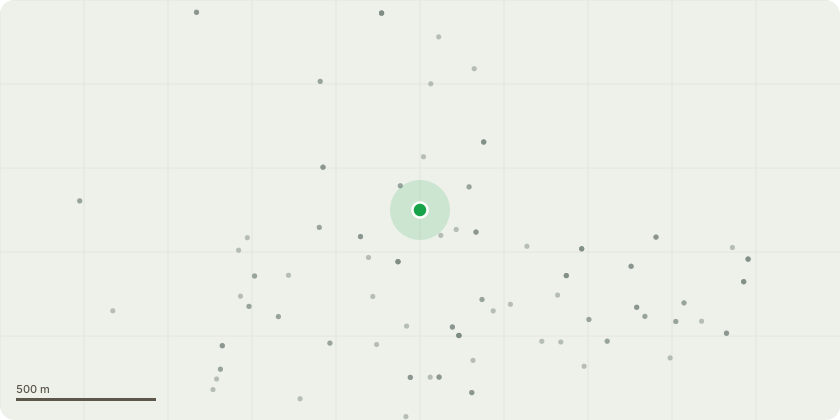
Approximate location
Proposal
Photograph 1 shows 3 oak trees, from left to right, T1, T2, T3, from North to South. All 3 have TPOs. T1 is positioned slightly forward (west) of T2 and T3, the latter of which are at the rear boundary of the property (east). T2 and T3 are healthy. T1 was healthy when we moved to the property in 2009 and was trimmed circa 2010. When we trimmed (with planning permission) in circa 2020/21, there was no need to trim T1 as, unlike T2 and T3 it had not grown and it was clearly not in as healthy condition as T2 and T3. Photographs 1&2 show the inferior canopy, the ends of all branches being without leaves and inferior leaf formation. Photographs 3&4 show where bark is gradually falling from T1 revealing a dry, dark wood which sounds hollow when knocked. The 60cm gap in the bark is on the south side, there is also a 20cm gap on the north side of the tree. Further cracks in the bark, similar to those which precipitated the previous falling of bark are evident on the south side. Judging from the further cracks, I think that the area of exposed trunk will double when that bark falls. The progression of the shedding of bark is slow but steady - we first saw a small gap of bark approximately 5 years ago. With the dry, dark, dead interior exposed by the fallen bark, it is obvious that the tree is in distress. With the fact of its lack of growth and slow deterioration over 15 years, it is obvious that this is a permanent condition. I therefore apply to fully remove the diseased T1. I have 2 options of where to place a replacement oak to inherit the TPO and am suggesting that I plant oaks in both locations (one just north of T1 and one close to the southern boundary, south east of T3) then, at a later date (I suggest at least 5 years), see which has grown better and allocate the TPO to that one. There is possible damage to property if the diseased T1 were to fall. It would have to be precise, but, if it fell at just the wrong angle it is likely to hit the conservatory. At other an
Planning history / related applications
No related planning applications have been identified in the current public OGL dataset.
Inside plotEdge
Go beyond the public record
This page is the public OGL record. plotEdge adds the private intelligence layer for this site - open it in the app to unlock:
- Ownership & title Registered owner and title from HM Land Registry.
- Viability & build potential Site scoring and development upside.
- Constraints Flood risk, green belt, conservation areas and designations.
- Approval signal Planning risk and approval-likelihood analysis.
- Comparable applications Decisions on similar nearby sites, side by side.
- Status alerts Get notified the moment this application changes.
Source: public planning application data from Runnymede, reused under the Open Government Licence v3.0. View the council source record. Council documents and drawings are not republished on plotEdge.